Safe Infant Sleep Information For Parents
As a parent or caregiver, you can take steps to create a safe sleep environment for your baby. When you put your baby "safe to sleep" for every sleep, you reduce the risk of sudden unexpected infant death (SUID). The steps below can help keep your baby safe during sleep and in the sleep environment.
What You Can Do to Reduce the Risk of Sudden Unexpected Infant Death:
- Always place baby on their back to sleep, for naptime and nighttime.
- Use a firm and flat sleep surface, covered by a tightly, fitted sheet.
- Do not let your baby sleep in an adult bed, on a couch, or on a chair alone, with you, or with anyone else.
- Room sharing—keeping baby's sleep area in the same room where you sleep—reduces the risk of SUID.
- If you bring baby into your bed to feed, put them back in a separate sleep area in your room, such as a safety-approved crib, bassinet, or portable play area, when you are finished.
- Keep soft objects including crib bumpers, toys, and loose bedding out of baby's sleep area.
- Get regular healthcare during pregnancy.
- Do not smoke, drink alcohol, or use cannabis or illegal drugs during pregnancy or after the baby is born. Do not allow smoking of any kind around your baby.
- Breastfeed your baby.
- Once breastfeeding is firmly established, give your baby a dry pacifier that is not attached to a string for naptime and nighttime.
- Do not let your baby get too hot during sleep.
- Follow healthcare professional guidance on baby's vaccines and regular health checkups.
- Avoid products that claim to reduce the risk of SUID and other sleep-related causes of infant death.
- Do not use home heart or breathing monitors to reduce the risk of SUID.
- Give baby plenty of supervised "tummy time" when they are awake. Tummy time helps baby's head, neck, and shoulder muscles get stronger and helps prevent flat spots on the head.
- Spread the word. Tell grandparents, babysitters, child care providers, and other caregivers to always place your baby on his or her back to sleep to reduce the risk of SIDS. Babies who usually sleep on their backs but who are then placed on their stomachs, even for a nap, are at very high risk for SIDS—so every sleep time counts.
- Consider requesting a free, confidential home visit to ask questions and get help setting up a safe sleep environment.
What We Do
- Conduct free, confidential home visits for pregnant women and families with children up to age three. Family visitors can help you set up a safe sleep environment for your baby.
- Provide breastfeeding support for eligible women through the Women, Infants, and Children (WIC) Program.
- Offer support to help people quit smoking.
- Partner with healthcare professionals, birthing hospitals, child care providers, social service providers, home visitors, and community-based organizations to promote safe sleep practices.
- Convene a statewide team of experts to review all child deaths cases and to identify ways to prevent similar deaths from occurring.
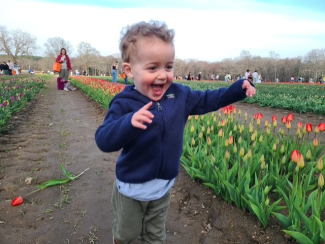
Meet Owen and read his #SafeSleepStory
"Ellie couldn’t wait to meet her baby brother, and when Owen arrived she was eager to help us take care of him. Ellie was a toddler when Owen was born, and her idea of helping was to make sure he was surrounded at all times by his toys, stuffed animals, and blankets. Although we kept explaining that it was important that Owen sleep alone, Ellie was intent that her baby brother not be lonely. I can’t remember how many times we had to remove the toys and blankets out of the Pack ‘n’ Play and crib before putting Owen to sleep. Today, Owen is a toddler and Ellie is going into first grade. We’re past the safe sleep stage and working on keeping Owen from climbing out of his toddler bed. Safety first!" - Sidra, parent
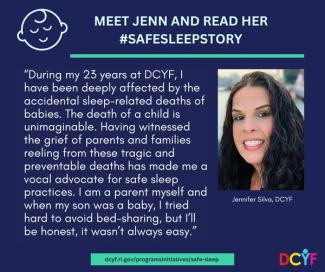
Meet Jenn and read her #SafeSleepStory
"During my 23 years at DCYF, I have been deeply affected by the accidental sleep-related deaths of babies. The death of a child is unimaginable. Having witnessed the grief of parents and families reeling from these tragic and preventable deaths has made me a vocal advocate for safe sleep practices. I am a parent myself and when my son was a baby, I tried hard to avoid bed-sharing, but I'll be honest, it wasn't always easy." - Jenn, parent and DCYF employee
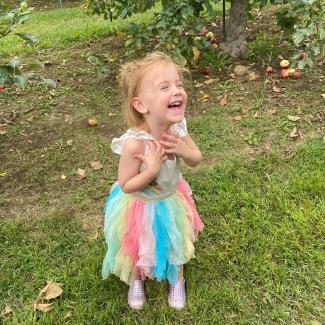
Meet Ellie and read her #SafeSleepStory
"We were new parents and didn’t know what to expect. We had heard that the newborn stage can be challenging. We followed the “share a room, not a bed” guidance, keeping Ellie in her bassinet in our room for the first few months. When we transitioned her to a crib in her room, everyone’s sleeping improved dramatically. We did the best we could as first-time parents, and we were lucky to have the support of family and friends. Ellie is three now and thriving and sassy as ever." - Sidra, parent
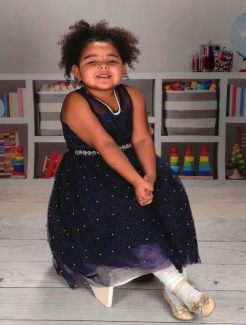
Meet A’Kirah and read her #SafeSleepStory
"My child A'Kirah is now 4 years old, but when she was a baby I did my best to practice safe sleep. It wasn’t always easy; A'Kirah was colicky and we struggled with getting her to fall asleep and stay asleep without being held. I struggled with trying not to co-sleep. Our pediatrician suggested we swaddle her with a safe sleep swaddler. I found that using the safe sleep swaddler and putting her on her back, in her crib, and without any blankets worked! Not only was she finally able to fall asleep without being held, she slept safely for longer periods of time." - Tiffaine, parent

Meet Jack and read his #SafeSleepStory
"Jack had acid reflux as a baby and was up at night very often and always wanted to be held. I knew the importance of safe sleep, and knew I needed to stay awake when I was up with him in the middle of the night. So, I developed strategies to stay awake. This included texting with my mom friends in the middle of the night while I was breastfeeding, and leaning on my husband, who was always willing to do middle of the night diaper changes. I also caught up on my favorite shows and social media feed while breastfeeding at night. We did not bed share and always placed Jack to sleep on his back." - Ashley, parent
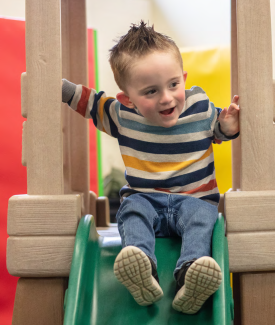
Meet Aiden and read his #SafeSleepStory
"My child Aiden is now 3 years old. When he was born, he spent 59 days in the newborn intensive care unit (NICU). The hospital taught us all the best sleep practices. We were so nervous to have him home, but we did our best to practice safe sleep. It wasn’t easy, but we always put him to sleep on his back and in his crib, and a great baby monitor helped us keep an eye on him while he slept. Aiden had reflux, and sometimes it was difficult for him to sleep, so we kept in touch with our pediatrician to make sure whatever we were doing aligned with Aiden sleeping safely. It was sometimes emotionally draining, but now Aiden has great sleep habits, which is helpful now that he has a little sister." - Laura, South Kingstown
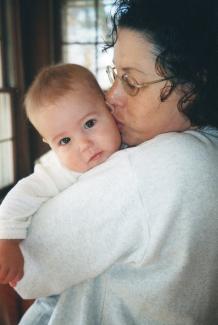
Meet Daisy Mae and read her #SafeSleepStory
"I am the Chief of the Safe Sleep Program at the Rhode Island Department of Health and I have a confession: I did not practice safe sleep.
Back in the day, 24 years ago, I breastfed my one and only, Daisy Mae, in bed and in the rocking chair and on the sofa... and I always, always fell asleep. I decorated her crib with bumpers, blankets, and stuffed animals... and in said crib, I propped her on her side with a wedge because the pediatrician said I could.
How times have changed! Today, after too many years of preventable sleep-related deaths of babies under the age of one across the United States and in Rhode Island, the evidence points to the fact that everything I just described actually increased the risk of my baby experiencing a bad outcome so unimaginable, I have trouble saying it out loud.
These days, Daisy Mae is adulting and doing her thing, and I’m doing mine; providing safe sleep education and resources in the hope that no Rhode Island family ever again has to experience the preventable death of a baby during sleep or in the sleep environment." - Margo, Chief, RIDOH Safe Sleep Program
Share on Facebook

Meet Jola and read her #SafeSleepStory
"Before having my first child in 2019, I placed a tremendous amount of pressure on myself. My training in public health and professional background in injury prevention made me feel like I needed to know all the answers and make all the right decisions from the get-go. In hindsight, being a first-time mother required forgiveness and grace to navigate my transition to parenthood.
When I was pregnant, we were on a mission to design and decorate the perfect nursery. We purchased a crib and bassinet that I decorated with soft blankets and stuffed animals. It was only when I brought my newborn daughter into her nursery for the first time, that I understood the potential dangers that the blankets and stuffed animals posed. Holding her in my arms, all seven pounds of her, my daughter’s vulnerability, and my responsibility to protect her could not have been more clear. I made the decision right then and there to prioritize safety over appearance and removed all the soft objects from her crib and bassinet.
The conflict between aesthetics and safety was brought home to me that day. My experience as a parent has deepened my appreciation for the importance of education, support and honest conversations to help families navigate safe sleep decisions at home." - Jola, parent
Share on Facebook

Meet Kerry and read her #SafeSleepStory
"Long before I became a mother, working at the Rhode Island Medical Examiner’s office changed the way I understood risk, sleep, and motherhood. By the time I had the first of my three babies, I had already seen, far too many times, the terrible accidents that can happen when exhaustion, love, and desperation collide in the middle of the night.
Anyone who has had a baby knows that newborns are relentless; days and nights are a blur, and your body and mind ache for uninterrupted sleep. The bonding and intimacy that bed-sharing brings was enticing but based on the preventable infant sleep-related deaths I had seen at work, I could not ignore the risks. I faithfully followed the safe sleep guidelines: alone in the crib, on her back, no blankets or other soft objects... and no sleeping together.
It wasn’t easy, but my kids were worth it. The bonds I have with them, now teens and young adults, were and are unwaveringly strong. However difficult my job can be, I value the lessons from it; that tragedy does not always result from recklessness. Sometimes it results from just being human." - Kerry, parent
Share on Facebook

Meet Jack and read his #SafeSleepStory
"I cherished the quiet moments bonding with Jack as I breastfed him. On top of the exhaustion that comes from having a new baby in the house, I struggled to fight the drowsiness that the breastfeeding hormones, oxytocin and prolactin, brought with them. Aware of the important health benefits of breastfeeding, including the association with a reduced risk of sudden infant death syndrome (SIDS), breastfeeding was, for both me and my baby, a priority. One night, while breastfeeding Jack, I unintentionally fell asleep. That scared me. I started setting a timer on my phone during nighttime feedings. This simple but practical strategy gave me peace of mind by helping me to stay awake and alert during those exhausting overnight hours." - Erin, parent
Share on Facebook
Prevent Sleep-related Infant Deaths
Room Share, Don't Bed Share
Set an Alarm Every Time You Breastfeed
How to Support a New Parent
Safer Sleep Through Connection
More
Resources
- The Science Behind Safe Infant Sleep (Podcast)
- Safe Sleep Awareness Campaign
- Safe Sleep Awareness Social Media Campaign
- Safe to Sleep
- SIDS & Other Sleep-Related Infant Deaths: Expansion of Recommendations for a Safe Infant Sleeping Environment Technical Policy Statement
- Healthy moms and babies
Flyers
- What Does A Safe Sleep Environment Look Like? (Spanish) (Portuguese) (Cape Verdean Creole) (Haitian Creole)
Posters
News
- November 20, 2025: Children’s items sold on Amazon pulled nationwide over risk of fatalities
- November 4, 2025: The Alarming Rise of Unsafe Baby Sleep Advice Online
- April 6, 2025: Co-Sleeping, No Matter Where, Raises the Risk of Sudden Infant Death, Data Show
- October 10, 2024: Fisher-Price Recalls More than 2 Million Snuga Infant Swings Due to Suffocation Hazard After 5 Deaths Reported | CPSC.gov
- August 6, 2024: U.S. lawmakers propose a ban on weighted infant sleepwear : NPR
- March 28, 2024: Forias Pack and Play Mattresses Recalled Due to Suffocation Hazard for Infants; Violations of the Federal Safety Regulation for Crib Mattresses; Sold Exclusively on Amazon.com by Forias Direct
- March 7, 2024: Jool Baby Recalls Nova Baby Infant Swings Due to Suffocation Hazard; Violation of the Federal Safety Regulations