Eating Fish Safely
What you should do
Eat fish as part of a balanced diet
Fish, shellfish, and seaweed are nutritious sources of food. They may provide omega-3 fatty acids, protein, iron, iodine, and choline to the diet. These nutrients support heart and brain health at all ages and are especially important during pregnancy, breastfeeding, and early childhood.
How much seafood should I eat?
Women of childbearing age should eat two to three servings each week and children older than age two should try to eat about two servings of seafood from the "best choices" list each week. Other adults should eat at least two servings of seafood.
What if I can’t eat fish?
Seaweed and algae are another good option because they have many of the same nutrients as fish, including the same omega-3 fatty acids, and are less likely to have pollutants.
Supplements, such as cod liver oil, prenatal vitamins, and those added to baby formula, are also a good alternative. These supplements provide the long chain omega-3 fatty acids the body needs, but do not provide the other benefits of dietary fish consumption.
Health Risks
What about pollutants in fish?
Fish are good to eat, but some have higher levels of toxins than others. Mercury and other pollutants can build up in the bodies of living things, especially larger fish people often eat.
Mercury can harm brain development at relatively low levels and can be toxic to adults at high levels. Mercury is found in nearly all fish and is the biggest concern for eating fish. Other pollutants that are sometimes found in fish can cause cancer or other health problems. The levels of these pollutants are low enough that the health benefits of fish consumption outweigh the risk of health effects, except in extreme cases. Different types of fish have different levels of pollutants. You can further limit the risk by considering the types of fish you eat.
What about fish I catch myself?
Eating fish is good for you, but fish caught in polluted waters can harm your health. The type of fish you catch – and where you catch the fish – is important. The information here can help you learn more about how to safely eat the fish you catch:
Saltwater Fish
Saltwater fish you catch in Rhode Island saltwater bodies have the same health benefits and similar levels of pollutants as saltwater fish you may buy in a store. Learn more about eating saltwater fish safely at Advice about Eating Fish | FDA.
Freshwater Fish
Freshwater fish are fish caught in freshwater bodies of water. Freshwater fish caught in rural areas of Rhode Island may contain contaminant levels that are concerning. Freshwater fish caught in urban areas of Rhode Island may also contain contaminants.
Many Trout and Sunfish (for example, Pumpkinseed and Blue Gill) that you may catch in Rhode Island lakes and streams are generally safe to eat. But it is important to check RIDOH’s freshwater fish consumption advisories (see the advisory table below) for the most up-to-date information before you eat the fish you catch. RIDOH uses existing data to create freshwater fish advisories for fish caught in Rhode Island waters.
| Waterbody | Specific Location | Municipality | Contaminant/ Hazard | Advisory? | Meal Advice | Note |
|---|---|---|---|---|---|---|
| Pawcatuck River | Grills Preserve Pond1 | Westerly | PFAS, Mercury | Yes | Do not Eat | Read More: SiteInvestigationReportCard-Bradford-4.2.25 |
| Pawcatuck River | Downstream of Burdickville Road2 | Westerly | PFAS, Mercury | Yes | Once Per Month | Read More: SiteInvestigationReportCard-Bradford-4.2.25 |
| Woonasqutucket River – Centredale Manor | Downstream of Cricket Field Dam3 | Johnston | Dioxins & dioxin-like PCBs | Yes | Do Not Eat | Read More: SiteInvestigationReportCard-Centerdale-12.15.25 |
Abbreviations
- PCB=polychlorinated biphenyls
- PFAS=per- and polyfluoroalkyl substances
Notes
- You should not eat fish in the Grills Preserve Pond.
- You can eat native fish from the Pawcatuck River downstream of Burdickville Road once per month.
- Avoid eating fish from the Woonasquatucket River downstream (below) the dam at Cricket Field in Johnston. You can consume fish from above the dam at Cricket Field, but limit consumption of top predators like Largemouth Bass, Northern Pike, or Pickerel.
Upper Melville Pond (also known as Thurston Gray Pond) in Portsmouth, RI, was closed to fishing from May 4, 2026, to early July 2026 while a study was conducted. The Rhode Island Department of Health (RIDOH), Rhode Island Department of Environmental Management (DEM), US Environmental Protection Agency (EPA), Roger Williams University (RWU), and the Town of Portsmouth recently completed this study to examine how long it takes for PFAS (Per- And Polyfluoroalkyl Substances) | Department of Health to accumulate in stocked trout.
Can I still fish in the Melville Ponds?
Now that the study is complete, Upper Melville Pond is open to fishing. The results of the study are being analyzed and findings are expected to be released in 2027. Learn more about freshwater fishing at www.dem.ri.gov/fishing.
About the Melville Pond Study
Upper and Lower Melville Pond were originally built by the US Navy as drinking water reservoirs for Naval Station Newport. The ponds are located near the former Melville Fuel Defense Support Point, where PFAS-containing firefighting foam was used. This area is part of the Newport Naval Education & Training Center Superfund Site. Sampling performed by DEM detected elevated levels of PFAS in the Upper and Lower Melville Ponds.
This study, the first of its kind in Rhode Island, will track how quickly PFAS accumulates in the tissue of stocked fish. During the study, DEM will anesthetize and fin-clip stocked trout in the pond. They will work with RWU to collect samples of stocked trout every two weeks and then transport them to RWU and EPA labs for testing. Water and sediment samples will also be collected for PFAS analysis. More information about DEM’s involvement in this project can be found here: Study to Examine PFAS Impacts on Stocked Trout | Rhode Island Department of Environmental Management
RIDOH will use data from the study to make recommendations designed to lower PFAS exposure when fishing. The results are expected next year and will help guide efforts to minimize PFAS exposure. The study is funded by RIDOH and DEM.
For more information about PFAS uptake in stocked fish, visit: Bradford Dyeing Association.
What about shellfish?
Shellfish you buy are nutritious and low in chemical pollutants. They should be properly cooked or they can make you sick (bacterial infection). Only gather shellfish from areas that are approved by the Rhode Island Department of Environmental Management (RIDEM)for shellfishing. Visit RIDEM website for more details on safe shellfish consumption.
Poison Hotline 24 Hours a Day - 1-800-222-1222
Promotional Material
Reports
- Project Assessment of Consumer Awareness About Mercury in Fish
- Summary of Bradford Dyeing Association Health Risks and Recommendations
- Bradford Dyeing Association Health Consultation Report (2024-12)
- Bradford Dyeing Association Addendum on Stocked Trout (2025-04)
Web Pages
More Information about PFAS in Fish
Freshwater Fish Meal Framework for future Fish Meal Recommendations and Advisories
- Perfluorooctane sulfonate (PFOS) is one of the most common and well-studied PFAS compounds and tends to accumulate in fish tissue. RIDOH has completed a technical report called a Health Consultation on PFAS in freshwater fish tissue after studying samples from nine water bodies in Rhode Island.
- As a result of this work, RIDOH has developed a PFOS-based meal recommendation framework to guide future freshwater fish consumption recommendations. This framework is supported by current scientific evidence and provides a balanced public health approach to consuming freshwater fish. You can read more about how this framework was developed in this Health Consultation.
-
The PFOS concentration categories in this framework align with the range of concentrations observed in largemouth bass from the nine Rhode Island freshwater water bodies evaluated in the Health Consultation. Adopting this framework provides RIDOH with a consistent, transparent, and science-based screening tool that recognizes certain limitations associated with fish tissue samples used in this specific evaluation.
RIDOH Framework* Meal Category PFOS Concentration (ng/g) Unlimited < 4 1 meal/ week ≥ 4 to 8 1 meal/month ≥ 8 to < 31 Do not Eat ≥ 31 * This framework is intended to guide future public health decision-making when current PFAS fish tissue data are available. It does not constitute a fish consumption advisory for the water bodies evaluated in this report because the archived data are limited and may not reflect current conditions.
- PFAS concentrations are typically lower in saltwater fish. People concerned about PFAS should consider fishing in saltwater areas like Narragansett Bay and the Atlantic Ocean. In addition, lower trophic species may bioaccumulate less PFAS than largemouth bass.
- Fishing is an important part of outdoor recreation, community traditions, and, for some people, an important source of food. While PFAS is not good for your health, fish is a very healthy food and a source of essential nutrients. People should weigh the benefits of eating fish against the potential risks from contamination.
- Read more about Risk-Benefit Considerations in the 2025 PFOS Best Practice Guidelines Great Lakes Consortium for Fish Consumption Advisories document.
- There are many ways to reduce the health risks posed by PFAS other than reducing fish consumption. Learn more about ways to reduce health risks of PFAS.
Information about Mercury in Fish
Individuals who are pregnant, planning to become pregnant, breastfeeding, or feeding young children should choose fish that are low in mercury. Mercury is a toxic metal that can interfere with the developing brain and nervous system, potentially affecting learning, movement, and behavior.
Larger and more mature fish tend to accumulate higher concentrations of mercury. People who are pregnant or planning a pregnancy, breastfeeding, and children younger than 6 years should avoid fish known to have elevated mercury levels.
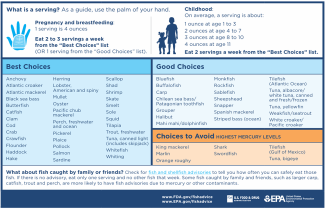
This chart can help you choose which fish to eat, and how often to eat them, based on their mercury levels. These guidelines were developed by the US Food and Drug Administration (FDA) and US Environmental Protection Agency (EPA). Go to www.fda.gov/FishAdvice for more information about eating fish.
Maximum Average Mercury Concentrations by Meal Recommendation Category
| Chart Category | Mercury Concentration Values (ug/g) | Meals per week |
| Best Choice | ≤ 0.15 | 3 |
| Good Choice | ≤ 0.23 | 2 |
| Good Choice | ≤0.46 | 1 |
| Choices to Avoid | > 0.46 | 0 |
This table shows the maximum average mercury concentration associated with each meal recommendation category. For more information about how these categories and meal recommendations were developed, see Technical Information on Development of FDA/EPA Advice about Eating Fish for Those Who Might Become or Are Pregnant or Breastfeeding and Children Ages 1-11 Years | FDA.
In Rhode Island, American eel, chain pickerel, largemouth bass, white perch, and yellow perch are freshwater species that have historically been found to contain elevated mercury levels in certain waterbodies. Additional fish tissue sampling and analysis is needed to develop waterbody-specific mercury consumption recommendations. RIDOH is working to develop an interactive map that will provide available mercury monitoring data for freshwater fish across the state.
See the most recent RIDEM water quality report: 2024 INTEGRATED WATER QUALITY MONITORING AND ASSESSMENT REPORT for the history and current status of mercury monitoring in fish.